SCX January/February releases, photos of many of the cars coming later Tuesday.
Analog
63580 Plymouth Barracuda #48
64390 Interstate Batteries #18
64400 Army #39
64410 Office Depot/Old Spice #14
64420 Plymouth Barracuda #42
64490 Audi R10
64500 Alpine A110
64510 Peugeot 307
64540 Lancia Delta
64550 Fiat 850 Abarth
64560 Ford Escort MKII
64700 Ford Escort MKII M.E.
Digital
13990 Plymouth Barracuda #42
14000 Plymouth Barracuda #48
14010 Audi R10
14020 Interstate Batteries #18
14030 Army #39
14040 Office Depot/Old Spice #14
PRO
50710 Army #39
50720 Office Depot/Old Spice #14
50730 Interstate Batteries #18
AutoArt Porsche 911 RSR Flying Lizard Motor Sport Diecast
I had the good fortune to get a AutoArt 1/18th scale Flying Lizard Motor Sports Porsche 911 RSR. The Lizards are a favorite team of mine and it was a really great day to see this car show up. Now I'm really not much of a diecast person... I usually like my car models with a small electric motor and guide tucked under the nose, but this car really works for me on pretty much every level.
 The profile is the first thing I always look at when I find a Porsche model. Most often there's some small contour that just doesn't work for me, something that just catches my eye and tells me that what I'm looking at is a toy and not something that captures the real Porsche-ness needed to satisfy an overly critical eye. This car has none of those lines, it's a Porsche from front to back.

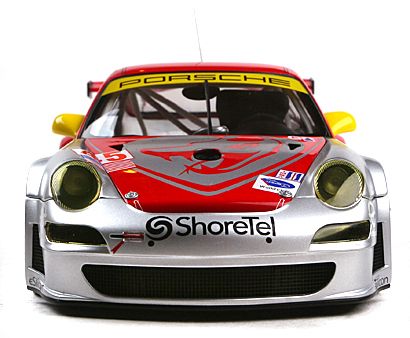
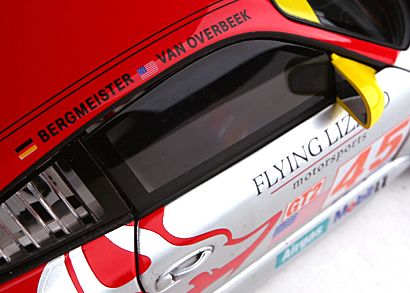
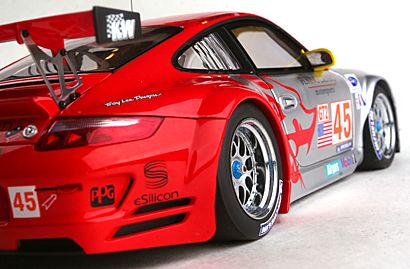
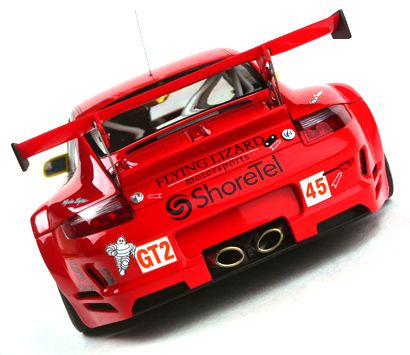 The details on the car are just stunning. The printing is perfect and crisp and the red is rich and deep.
 The finish on the wheels is perfect. From the Porsche logo on the center hub of the wheels to the "Brembo" logo on the brake calipers. Rivets around the edges of the models of the two-piece wheels is well done and the contours of the BBS wheels are true to the real wheels.
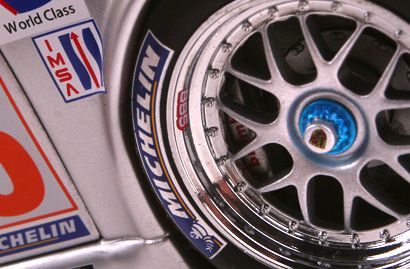 The contours of the body are excellent and AutoArt really nailed the feel of "volume" that the RSR has. The tires and wheels have the "bulk" that they should have in proportion to the wheel arches.
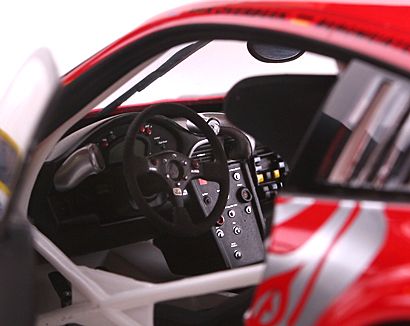
 The doors open well and reveal a highly detailed interior and dash instrument panel. Air vents and interior roll bars and representations of interior wiring details.
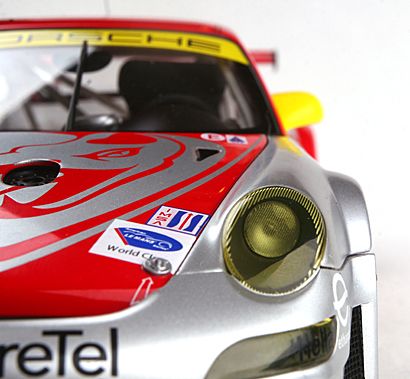
 A bit of a surprise to me was the very, very fine detail on the headlight lenses... the excellent "eyes" on this car really seal the deal.
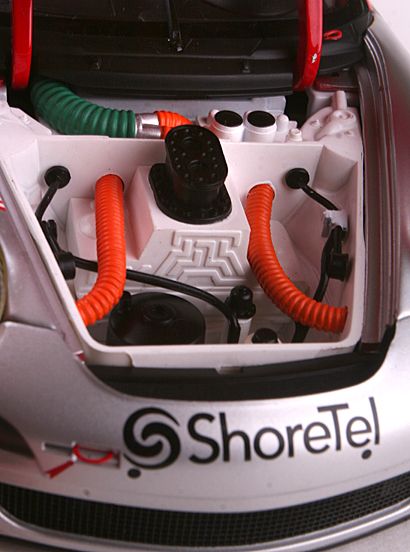
 Under the hood the details continue. The hood is a bit too heavy to stay up without a helpful finger, though it does close with an appropriate "thunk!"
 I would like to have such a perfect RSR as a slot car but as the Porsche slot fans know there isn't one that quite measures up yet. Normally I look at a diecast and feel somewhat "wanting" I want it to move I want it to be able to sort of .... well... live, much like slot cars do when you're tearing ass around the track with them.
Maybe it's because this is my favorite race car, maybe it's because this car is as perfect as it is. This car just works, buy one you won't be sorry.
Listing of the car on the AutoArt website.
Dave K
Publisher, Slot Car News
The profile is the first thing I always look at when I find a Porsche model. Most often there's some small contour that just doesn't work for me, something that just catches my eye and tells me that what I'm looking at is a toy and not something that captures the real Porsche-ness needed to satisfy an overly critical eye. This car has none of those lines, it's a Porsche from front to back.The details on the car are just stunning. The printing is perfect and crisp and the red is rich and deep.The finish on the wheels is perfect. From the Porsche logo on the center hub of the wheels to the "Brembo" logo on the brake calipers. Rivets around the edges of the models of the two-piece wheels is well done and the contours of the BBS wheels are true to the real wheels.The contours of the body are excellent and AutoArt really nailed the feel of "volume" that the RSR has. The tires and wheels have the "bulk" that they should have in proportion to the wheel arches.The doors open well and reveal a highly detailed interior and dash instrument panel. Air vents and interior roll bars and representations of interior wiring details.A bit of a surprise to me was the very, very fine detail on the headlight lenses... the excellent "eyes" on this car really seal the deal.Under the hood the details continue. The hood is a bit too heavy to stay up without a helpful finger, though it does close with an appropriate "thunk!"I would like to have such a perfect RSR as a slot car but as the Porsche slot fans know there isn't one that quite measures up yet. Normally I look at a diecast and feel somewhat "wanting" I want it to move I want it to be able to sort of .... well... live, much like slot cars do when you're tearing ass around the track with them.Maybe it's because this is my favorite race car, maybe it's because this car is as perfect as it is. This car just works, buy one you won't be sorry.
Listing of the car on the AutoArt website.
Dave K
Publisher, Slot Car News

Mighty fine 2009: the best that I could do
As I searched for the right words to begin this post, I was heading into the final sunrise of the year at 30,000 feet, having left the place of my birth far behind me. Looking back on 2009 I was at a loss to find any accomplishments that were truly momentous. Most were relative to the bike obsession only, achievements that are meaningless to anybody with hairy legs. I felt an immediate compulsion to declare 2010 the Year of Getting Something done. However, upon arrival in Chicago that night, amid good friends and wine, I realized that I'd already done it. I had started the year utterly alone in searching for deeper meaning, and that night I was ending it with new found purpose and a positive spirit to guide me there.
365 days earlier, New Year’s Day began epically enough, with a full body hangover and a kitchen that hearkened back to my college days standards of cleanliness. The night before we’d hosted a 12-course dinner to ring in the New Year and judging by the all the empty dishes I set about ignoring, it was a smashing success. I smiled briefly at the empty Jell-O shots on the floor.
First things first: coffee and recovery while I waited for Katy to wake up. The Dark Knight got me through until it was time to clean up the mess.
It wasn’t as bad as it looked and we mowed through the worst of the baked-on grease, dried cheese, and heavy pots pretty quickly. While she went back to bed, I settled into the remainder of the Winter Classic from Wrigley Field, smiling as NBC tried to drown out the chant of “Detroit sucks!” from the raucous crowd, in front of me a huge plate of scrambled eggs, bacon, and a gourmet Bloody Mary using the leftovers from last night, including the prime rib and stilton cheese. I found myself amidst the thick of an ice cold day where I'd not see the outside or even so much as a pair of pants, keeping my thoughts to myself as I watched movie after movie and delayed reality as much as possible.
And kept them to myself I did, all the way to the move out in late March which was as life-changing a day as I had ever experienced. Jack and I walked the mile and a half to my new apartment in Irving Park on a cool, spring evening at sunset and I wondered where else I was headed. I'd dreaded this day ever since I agreed to move in with Katy - not that I'd known it would end this way, but that it could - and here I was expecting the worst was still around the corner.
But what greeted me instead was clarity and simplification. Let me back up…
I was carrying with me, and still do, a heavy load of guilt for allowing my obsession with the bike to put such a gulf between me and the people I'd called friends since nearly 1999. Yet the late nights filled with cigarettes and alcohol no longer excite me because my mornings are much more important now. Would I rather wake up to nausea and a headache or the giddy anticipation of a soul-cleansing, five hour ride? I didn’t know what else to do than to make those relationships work as best they could under the circumstances while embracing the new friends I have.
But this last relationship wasn’t going to work under any circumstances. And moving into another apartment in less than a year had me second-guessing how important cycling competitively really was to me.
But that night as I walked into my new home, I looked down at Jack, who was of course looking right back at me. I then saw that our relationship was now another level completely. Back on January 1st we’d been contemplating sending him back to rescue…he just wasn’t working out…fitting in, we told ourselves…but in the end I just couldn’t do it. It wasn’t fair to him, he is just being himself: a hyper, food-driven, inquisitive, loves-to-cuddle 30-pound Rottweiler-terrier mix.
And so I took him with me. By making that conscious choice to include him in my new life changed everything. With him now the central focus, and moving next door to my friend who owned the building I was living in, I quickly became part of a close group of friends, all part of the neighborhood, all with dogs.
I then realized my time off of the bike was much more important as the time on it, and as soon as I did, I began reaping the harvest from a newly balanced approach to life. But it wasn't just me - suddenly I was among friends who's schedule and pace of life jibed with mine. My neighbor Mark is a bikemate who comes on my Saturday rides with me, and the rest, Tina, Susan, Rob, Cari and Scott, Kayla and Janucz are always up for a backyard hang or beers and Mexican food at El Potosi down the street.
It's not that nobody else in my life has been this for me - I know I must sound ungrateful to anyone else reading this - but the timing just couldn't be better.
As Tina said at Susan's New Year's Eve party, "Brian, of course you've done something this year! Look around you - you have a posse now!" And Rob drove it home the following Saturday: "you're the glue, man. Before, I never really hung out at our neighborhood joints, and we certainly didn't do much like the dinner parties you throw." Indeed, the week I moved in I made a knockout risotto Milanese and invited them all over to stand in my kitchen and eat it. Nothing more formal than that. We were up until two and I put 15 wine bottles into the recycling. I repeated with rabbit stew the week before Thanksgiving.
It was a really warm feeling just then, to realize I have such supportive friends who are on such a similar wavelength as I. The guilt and regret are still there, always will be, but I have to go with what works best.
In 2009, I think I found my soul. Imagine what I can do in 2010 with that.
Now, a look back , 2009's Top 20:
1. Quality time.
2. ...and then going too far.
3. The new whip.
4. Leaving for San Luis Obispo (and more).
5. Back to Mt. Mitchell.
6. The breakthrough.
7. Almost...
8.. Sherman Park.
9. Jack goes mobile.
10. Tandemonium.
11. Shut up and ride, asshole.
12. My favorite race of the season.
13. 500th post.
14. Charm City invasion.
15. My first cross race.
16. Party pooper.
17. Race day hooky.
18. Stew.
19. The smile.
20. Home for Christmas.
365 days earlier, New Year’s Day began epically enough, with a full body hangover and a kitchen that hearkened back to my college days standards of cleanliness. The night before we’d hosted a 12-course dinner to ring in the New Year and judging by the all the empty dishes I set about ignoring, it was a smashing success. I smiled briefly at the empty Jell-O shots on the floor.
First things first: coffee and recovery while I waited for Katy to wake up. The Dark Knight got me through until it was time to clean up the mess.
It wasn’t as bad as it looked and we mowed through the worst of the baked-on grease, dried cheese, and heavy pots pretty quickly. While she went back to bed, I settled into the remainder of the Winter Classic from Wrigley Field, smiling as NBC tried to drown out the chant of “Detroit sucks!” from the raucous crowd, in front of me a huge plate of scrambled eggs, bacon, and a gourmet Bloody Mary using the leftovers from last night, including the prime rib and stilton cheese. I found myself amidst the thick of an ice cold day where I'd not see the outside or even so much as a pair of pants, keeping my thoughts to myself as I watched movie after movie and delayed reality as much as possible.
And kept them to myself I did, all the way to the move out in late March which was as life-changing a day as I had ever experienced. Jack and I walked the mile and a half to my new apartment in Irving Park on a cool, spring evening at sunset and I wondered where else I was headed. I'd dreaded this day ever since I agreed to move in with Katy - not that I'd known it would end this way, but that it could - and here I was expecting the worst was still around the corner.
But what greeted me instead was clarity and simplification. Let me back up…
I was carrying with me, and still do, a heavy load of guilt for allowing my obsession with the bike to put such a gulf between me and the people I'd called friends since nearly 1999. Yet the late nights filled with cigarettes and alcohol no longer excite me because my mornings are much more important now. Would I rather wake up to nausea and a headache or the giddy anticipation of a soul-cleansing, five hour ride? I didn’t know what else to do than to make those relationships work as best they could under the circumstances while embracing the new friends I have.
But this last relationship wasn’t going to work under any circumstances. And moving into another apartment in less than a year had me second-guessing how important cycling competitively really was to me.
But that night as I walked into my new home, I looked down at Jack, who was of course looking right back at me. I then saw that our relationship was now another level completely. Back on January 1st we’d been contemplating sending him back to rescue…he just wasn’t working out…fitting in, we told ourselves…but in the end I just couldn’t do it. It wasn’t fair to him, he is just being himself: a hyper, food-driven, inquisitive, loves-to-cuddle 30-pound Rottweiler-terrier mix.
And so I took him with me. By making that conscious choice to include him in my new life changed everything. With him now the central focus, and moving next door to my friend who owned the building I was living in, I quickly became part of a close group of friends, all part of the neighborhood, all with dogs.
I then realized my time off of the bike was much more important as the time on it, and as soon as I did, I began reaping the harvest from a newly balanced approach to life. But it wasn't just me - suddenly I was among friends who's schedule and pace of life jibed with mine. My neighbor Mark is a bikemate who comes on my Saturday rides with me, and the rest, Tina, Susan, Rob, Cari and Scott, Kayla and Janucz are always up for a backyard hang or beers and Mexican food at El Potosi down the street.
It's not that nobody else in my life has been this for me - I know I must sound ungrateful to anyone else reading this - but the timing just couldn't be better.
As Tina said at Susan's New Year's Eve party, "Brian, of course you've done something this year! Look around you - you have a posse now!" And Rob drove it home the following Saturday: "you're the glue, man. Before, I never really hung out at our neighborhood joints, and we certainly didn't do much like the dinner parties you throw." Indeed, the week I moved in I made a knockout risotto Milanese and invited them all over to stand in my kitchen and eat it. Nothing more formal than that. We were up until two and I put 15 wine bottles into the recycling. I repeated with rabbit stew the week before Thanksgiving.
It was a really warm feeling just then, to realize I have such supportive friends who are on such a similar wavelength as I. The guilt and regret are still there, always will be, but I have to go with what works best.
In 2009, I think I found my soul. Imagine what I can do in 2010 with that.
Now, a look back , 2009's Top 20:
1. Quality time.
2. ...and then going too far.
3. The new whip.
4. Leaving for San Luis Obispo (and more).
5. Back to Mt. Mitchell.
6. The breakthrough.
7. Almost...
8.. Sherman Park.
9. Jack goes mobile.
10. Tandemonium.
11. Shut up and ride, asshole.
12. My favorite race of the season.
13. 500th post.
14. Charm City invasion.
15. My first cross race.
16. Party pooper.
17. Race day hooky.
18. Stew.
19. The smile.
20. Home for Christmas.
HST 344 Syllabus, The Automobile and American Life, Spring 2010

Hi folks-- after a nice and productive sabbatical it is back into the classroom! The following syllabus serves as only a preliminary guide to my course this term, as modifications will take place during the term. Sorry for formatting problems -- this happens when I try to insert the Word file into this blog site.
HST 344 -- Science, Technology and the Modern Corporation: The Automobile and American Life
Class Meeting: MWF 1-1:50 p.m., HM 125
Instructor: John A. Heitmann
Office: 435HM (x92803).
Office Hours: 10:00-10:50 MWF or by appointment
E-Mail: John.Heitmann@notes.udayton.edu
Home page: http://homepages.udayton.edu/~heitmann/
Texts: John Heitmann, The Automobile and American Life.
Jack Keroauc, On the Road.
Ben Hamper, Rivethead.
Tom Wolfe, The Kandy-Kolored Tangerine-Flake Streamline Baby.
Grades: The final grade for this course will be based upon one Mid-Term Exam, (30%), Three Critical Book Reviews (40%), and Final Exam (30%). There is an option in terms of the book reviews. Instead of writing the three reviews, you may decided to write a term paper of 10-15 pages on a topic selected from a list that I will provide. However, you must make this decision no later than January 20. The grade scale is as follows: A 94 to 100; A- 90 to 93; B+ 87-89; B 84-86; B- 80 - 83; C+ 77-79; C 74-76; C- 70-73. A similar pattern applies to lower grades. Letter grades are assigned a mid-point numerical grade. Additionally, attendance can influence your final grade: if you miss more than 3 classes, one letter grade will be deducted from your grade; if you miss more than 6 classes, a two letter grade reduction will take place. A good grade for this course is a C+. Grade averages may be influenced by such factors as trends over the time of the course; for example, how you finish is far more important than how you start. Policies for exams strictly follows History Department Guidelines, and make-ups will only be offered with a valid, documented excuse.
Critical Book Reviews: Three critical reviews of assigned books serve as integral assignments in this course. Each review should be 3-5 pages in length, typed, double spaced. One should aim to critically summarize the book, aiming sure to discuss the authors content, themes, and perspectives, and then also provide an introspective response to the book that incorporates one’s own evaluation of the work’s authenticity and value.
Attendance at lectures is crucial if you are to expect a good grade in the course, and I want you to be at every class if that is at all possible. On many occasions material presented is not covered in the readings, and so many of the ideas discussed central to the development of modern science are complex and often confusing. Your attitude and what you bring in to the classroom can make the difference between a mediocre offering and a most positive educational experience.
Cheating and plagiarism will not be tolerated and offenses will be punished accordingly. A first offense will result in a failing grade for the exam or paper in question; a second offense will result in a failing grade for the course. Further, it is totally unacceptable to hand in a paper that is the result of work in another class.
Course Purpose: It has been said that the automobile is the perfect technological symbol of American culture, a tangible expression of our quest to level space, time and class, and a reflection of our restless mobility, social and otherwise. In this course we will explore together the place of the automobile in American life, and how it transformed business, life on the farm and in the city, the nature and organization of work, leisure time, and the arts. This is a most complex transition that we will study, as the automobile transformed everyday life and the environment in which we operate. It influenced the foods we eat; music we listen to; risks we take; places we visit; errands we run; emotions we feel; movies we watch; stress we endure; and, the air we breathe.
SCHEDULE OF LECTURES AND ASSIGNMENTS
The week of:
Week 1/January 4 Introduction; What our cars tell us about ourselves. The car in everyday life: the automobile age and its contradictions. Automotive Pioneers
Reading: Heitmann, .Introduction, Chapter 1.
Films: “Wild Wheels”; “The Secret Life of the Car; “Horatio’s Drive”
Week 2/January 11 Putting America on the Road; Henry Ford and the Model T
Reading: Heitmann, Chapter 2.
Film: “Automoible Parade;” “Gussle’s Day of Rest”
January 18 MLK Day
Week 3/January 20 The Rise of General Motors
Reading: Heitmann, pp. 54-63.
Film: “Master Hands”
Week 4/January 25 Advertising, Styling, Design and the Art of the Automobile
Reading: Heitmann, pp. 64-71.
Film: “Automobile Advertising 1910-1940.”
January 29 Review of Keroauc book is due: Film: “Kerouac”
Week 5/February 1 On the Road
Reading: Heitmann, Chapter 4.
Films: “Grapes of Wrath;” “Route 66;" “Detour.”
Week 6/ February 8 Religion, Courtship and Sex
Readings: Heitmann, Chapter 5.
Films: “Thelma and Louise”; “Motorcycle Diaries”
Week 7/ February 15 The Interwar Years: The Great Depression, Aerodynamics, and Cars of the Olympian Age
Readings: Heitmann, Chapter 6.
Films: “The Crowd Roars;” “Burn Em’Up Barnes.”
Week 8/February 22 World War II: Detroit, the Arsenal of Democracy
Readings: Heitmann, Chapter 7
Film: “Jitterbugs.”
February 26 Mid Term Exam
March 1-5 – Mid Term Break
”
Week 9/ March 8 The Post War Industry and Technological Suppression
Readings: Heitmann, pp. 133-154.
Film: “Tucker”
Week 10/ March 15 Chrome Dreams of the 1950s
Jan & Dean and the Beach Boys
Readings: Heitmann, pp.154-163.
Film: “American Graffiti”
March 15 Review of Wolfe Book is Due
Week 11/ March 22 The Rise of the American Muscle Car
Readings: Heitmann, pp.164-178.
Films: “Goldfinger;” “Thunderball” “Bullitt.”
Week 12/ March 29 & 31 Oil Shock I: Japan, James Bond, and Mobile Lovemaking
Readings: Heitmann, pp. 178-184.
Film: “Easy Rider;” “Gone in Sixty Seconds.”
Easter April 2 and 5
Week 14/April 7, 9 and 12 The Automobile World Upside Down, 1980s to the Present.
Readings: Heitmann, pp.185-194.
Film: “Fast and Furious;” “The Bourne Identity.”
April 14 Stander Symposium
April 16 Review of Ben Hamper book is Due
Week 15/April 19 The Automobile Industry and the Future; Sum Up
Reading: Heitmann, pp.194-206.
Film: “Cars.”
December 23 Last Day of Classes
Heitmann, Epilogue.
FINAL EXAM, April 26, 12:20 --2:10 p.m.
GTI Project... this rocks!!!!!
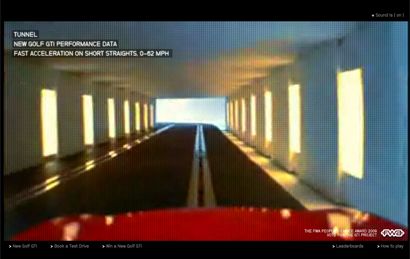
Go to this website and virtually race a GTI Golf around a slot track! Very cool see if you can get your name on the leaderboard! ...hopefully you'll do better than me! LOL.
http://www.gtiproject.com/
Porter Stansberry, Detroit, and the Future of America


Hi folks, I just finished The Road Scholar and Condescu's description of his visit to Detroit and then a friend sent me an short essay from Porter Stansberry on the city. Having just been to Detroit, and planning to go again in a few weeks to the Detroit Auto Show, I thought this work was most appropriate to post. Without question, America is at the tipping point, if it has not already tipped over. What Stansberry alludes to is trend that we pray will not continue. I have no idea who Stansberry is, whether a right wing crank or a legitimate scholar, but his ideas merit your consideration in this matter.
Stansberry writes of Detroit in October, 2009:
In 1961, the last Republican mayor of Detroit lost his re-election bid to a young, intelligent Democrat, with the overwhelming support of newly organized black voters. His name was Jerome Cavanagh. The incumbent was widely considered to be corrupt (and later served 10 years in prison for tax evasion). Cavanagh, a white man, pandered to poor underclass black voters.
He marched with Martin Luther King down the streets of Detroit in 1963. (Of course, marching with King was the right thing to do... It's just Cavanagh's motives were political not moral.) He instated aggressive affirmative action policies at City Hall. And most critically, he greatly expanded the role of the government in Detroit, taking advantage of President Lyndon Johnson's "Model Cities Program" – the first great experiment in centralized urban planning.
Mayor Cavanagh was the only elected official to serve on Johnson's task force. And Detroit received widespread acclaim for its leadership in the program, which attempted to turn a nine-square-mile section of the city (with 134,000 inhabitants) into a "model city." More than $400 million was spent trying to turn inner cities into shining new monuments to government planning. In short, the feds and Democratic city mayors were soon telling people where to live, what to build, and what businesses to open or close. In return, the people received cash, training, education, and health care.
The Model Cities program was a disaster for Detroit. But it did accomplish its real goal: The creation of a state-supported, Democratic political power base. The program also resulted in much higher taxes – which were easy to pitch to poor voters who didn't have to pay them. Cavanagh pushed a new income tax through the state legislature and a "commuter tax" on city workers.
Unfortunately, as with all socialist programs, lots of folks simply don't like being told what to do. Lots of folks don't like being plundered by the government. They don't like losing their jobs because of their race.
In Detroit, they didn't like paying new, large taxes to fund a largely black and Democratic political hegemony. And so, in 1966, more than 22,000 middle- and upper-class residents moved out of the city.
But what about the poor? As my friend Doug Casey likes to say, in the War on Poverty, the poor lost the most. In July 1967, police attempted to break up a late-night party in the middle of the new "Model City." The scene turned into the worst race riot of the 1960s. The violence killed more than 40 people and left more than 5,000 people homeless. One of the first stores to be looted was the black-owned pharmacy.
The largest black-owned clothing store in the city was also burned to the ground. Cavanagh did nothing to stop the riots, fearing a large police presence would make matters worse. Five days later, Johnson sent in two divisions of paratroopers to put down the insurrection. Over the next 18 months, an additional 140,000 upper- and middle-class residents – almost all of them white – left the city.
And so, you might rightfully ask... after five years of centralized planning, higher taxes, and a fleeing population, what did the government decide to do with its grand experiment, its "Model City"? You'll never guess...
Seeing it had accomplished nothing but failure, the government endeavored to do still more. The Model City program was expanded and enlarged by 1974's Community Development Block Grant Program. Here again, politicians would decide which groups (and even individuals) would receive state funds for various "renewal" schemes. Later, Big Business was brought into the fold. In exchange for various concessions, the Big Three automakers "gave" $488 million to the city for use in still more redevelopment schemes in the mid-1990s.
What happened? Even with all of their power and all of the money, centralized planners couldn't succeed with any of their plans. Nearly all of the upper and middle class left Detroit. The poor fled, too. The Model City area lost 63% of its population and 45% of its housing units from the inception of the program through 1990.
Even today, the crisis continues. At a recent auction of nearly 9,000 seized homes and lots, less than one-fifth of the available properties sold, even with bidding starting at $500. You literally can't give away most of the "Model City" areas today. The properties put up for sale last week represented an area the size of New York's Central Park. Total vacant land in Detroit now occupies an area the size of Boston – Detroit properties in foreclosure have more than tripled since 2007.
Every single mayor of Detroit since 1961 has been a Democrat. Every single mayor of Detroit since 1974 has been black. Detroit has been a major recipient of every major social program since the early 1960s and has received hundreds of billions of dollars in government grants, loans, and programs. We now have a black, Democrat president, who is promising to do to America as a whole what his political mentors have done to Detroit.
Those of you with a Democratic political affiliation may think what I've written above is biased or false. You may think what you like. But there is no way to argue that what the government has done to Detroit is anything but a horrendous crime. You may think what I've written above is merely a political analysis. Perhaps so, but politicians drive macroeconomic policy. And macroeconomic policy determines key financial metrics, like the trade-weighted value of a currency and key interest rates.
The likelihood America will become a giant Detroit is growing – rapidly. Politicians now control the banking sector, most of the manufacturing sector (including autos), a large amount of media, and are threatening to take over health care and the production of electricity (via cap and trade rules). These are the biggest threats to wealth in the history of our country. And these threats are causing the world's most accomplished and wealthy investors to actively short sell the United States – something that is unprecedented in my experience.
Subscribe to:
Posts (Atom)