Saab 23E Engine 1960 Saab 750 Gt Gran Turismo 1965 Saab 96
Hi folks -- truth be told, I loved those early Saabs. They were distinctive, utilitarian, a counterculture statement that simply said not all folks are obsessed with iron from Detroit. Saabs were aerodynamic, as you might expect, but with their 3-cylinder, 2cycle engines and front wheel drive they were indestructible and wonderful. Saab pioneered the use of the turbocharger in cars that the middle class drove. So GM came along, used their platform, kept the key in the console, and thought that we Americans would somehow buy them. 50 years from now, when the history of the decline of American industrial might is definitively written, there will be a lengthy chapter on GM's misdeeds!
I have seen more customers lower their car payments in December than ever before. It is easier to lower your payment at the end of the year because of the HUGE rebates and incentives on vehicles.
Is it possible to Lower Your Car Payments? Let me tell you the easiest way to find out. Go to Yahoo! Autos and pick the vehicle you are most interested in and get your FREE PRICE QUOTE. Put your contact information, select ALL DEALERS to get the best quote, then sit back and wait for the best price to be delivered to your email. The quotes will include all rebates and incentives that are currently available. Now, you pick the lowest price and contact that dealer with your trade in information. Tell them what it would take to trade, LOWER PAYMENTS!!!
Many customers are looking to lower their payments this time of year so dealers know how to make this happen. You can lower your payments by getting a better price on your New Car. How do I get the best price on a new car? This beats driving from dealer to dealer and sitting all day to find out that your payments are going up! Let dealers fight for your business for a change and you will be in the drivers seat, Literally! Go into the New Year with a Newer vehicle with a Lower Payment and remember, December 31st is the last day of the year and dealers are very eager to end strong so don't hesitate, go to How do I get the best price on a new car? NOW!!! This is a Totally FREE service, you can thank me later.
Hi folks -- see you at the 2010 Detroit Auto Show next month! The future of the auto industry in America certainly will continue to be a hot topic. Can you see the public buying a $40,000 Chevrolet, even if it is a plug-in hybrid? Can you see four well-fed Americans taking an interstate road trip in a Fiat 500? Looks like Ford will lead the way in 2010, unless surprises happen. And as we know, history teaches us that we should expect plenty of surprises!
Happy New Year to all who read this post! May you a have a blessed, prosperous, and above all peaceful new year! And may you always remain healthy and happy.
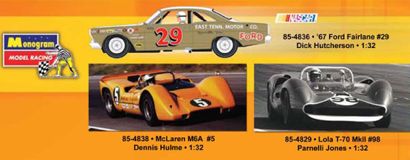
These three slot cars will be released by Revell in the first half of 2010. 85-4829 Lola T-70 MKII #98 Parnelli Jones 85-4836 Ford Fairlane #29 Dick Hutcherson 85-4838 McLaren M6A #5 Dennis Hulme
The real Christmas spirit manifested right after Hurricane Katrina in New Orleans in the form of a spray painted limo right after Wal-Mart was looted for spray paint. It seems even in the midst of disaster and bad times, street "artists" found a way to offer peace and season’s greetings. This could very well be the image that best describes the last ten years, that means its time to get your mad max vehicles ready for the next ten.
Hi folks -- there are still plenty of Saturns and Pontiacs left on dealer lots, and today GM provided more incentives to dealers to get these cars moved off inventories. Prior to today, there was a $6500 incentive or 0% financing available to buyers of these two brands. Now there is even more reason to buy if you can find the car you are looking for. Now that the snow has fallen, ice covers the lots, and we suffer with shorter days and little if any sun -- it is time to deal!!! For example, there are four G6s and 4 G8s available at the local dealer where I live. These cars, including a convertible, usually have a sticker price of $31,000+, but I'll bet you can get any of them for an incredibly lower price. Just watch out for financing and other ways the dealers may sock it to you to recoup losses.
December 30, 1936, marked the beginning of the Flint Sit Down Strike that ultimately led to the formation of the UAW and the unionization of the American automobile industry. There had been sit-down strikes in tat other plants in the days leading up to December 30, but it was in flint where the union was born, wages were increased dramatically, working conditions improved, and the dreaded "speed up" countered. Below is a more detailed and contextual account of this event. It is sad to note how the gains that American workers enjoyed have to some extent been lost, and how the future looks bleak for Americans in search of living wage jobs without a major commitment to higher education.
The Depression exacerbated labor woes. James Flink wrote, “Labor unrest in the automobile industry spread with massive unemployment and the deterioration of working conditions as the Depression deepened.” The crisis was compounded by technological stagnation, and since workers were more flexible than machines, human labor was pushed to increase productivity. Work on the assembly line was characterized by the “speed-up” and “stretch out” of the workforce. “Too many men competed for too few jobs and automobile manufacturers took advantage of the glut in the labor market.” Autoworkers of the 1930s had manifold complaints, but the foremost grievance was the speed-up. Workers argued bitterly that the speed of the line was unbearable; that annual earnings were inadequate; methods of payment were too complicated; the seasonal unemployment created by the industry’s insistence upon an annual model change; the practice of shutting down during the model changes (at Ford) and of hiring workers, regardless of skill, at the starting rate; management ignored and refused to recognize seniority; workers over 40 found it difficult to remain employed; female labor was being substituted to replace male labor; the continued “speed-up” of the assembly line; and the espionage networks and the Bennett regime of Ford. Mounting complaints would give impetus to a fledgling union movement.
Under the auspices of the New Deal, Congress passed the Wagner Act and created the National Labor Relations Board (NLRB). The original agreement was admittedly weak; it only stipulated requirements for worker representation, and automobile companies continued to resist unionization. The promises of the Wagner Act eventually came to fruition. “In only ten years,” noted historian Richard Oestriecher, “the Wagner Act led directly to an increase in union representation from approximately one worker in ten in 1934 . . . to more than three out of 10 by 1945, and strong unions forced corporations to raise wages at roughly the same rate that the economy expanded.” Concurrent with the Wagner Act, the American Federation of Labor (AFL) chartered the United Automobile Workers of America (UAW).
Even under the aegis of the Great Depression and the New Deal political climate, the “Big Three” were able to thwart worker’s attempts to organize. Unionization of the automobile industry was not concluded when the ink of the Wagner Act dried. Ford used a police regime to prevent violence; General Motors, Chrysler, and other firms embarked on campaigns of espionage. It was said at the time that one out of ten workers was a company informant. To unionize the auto industry, American politics had to be moved to the left. In Management and Managed Steven Jeffreys argued that the external political environment was crucial in shaping the limits of unionization. He observed that the Roosevelt labor coalition had left the “business community exposed.” Jeffreys’ thesis is also important because it recognized that “different patterns of managerial authority developed in different plants.” Labor unrest is a microcosm of larger political effects on the American social fabric. The historical experience of unionization was complex, and thus different in every company, and then every plant within that company. A high number of automobile strikes followed FDR’s 1932 election.
Companies battled to maintain Detroit’s reputation as an open shop city. Historians have noted several reasons for the auto industry’s ability to resist industrialization. First, both the AFL and communist organizations bungled opportunities to organize autoworkers. A proper political mechanism was not realized until a group within the AFL created the Congress of Industrial Organizations (CIO), which intended to jettison the AFL’s craft principle to organize workers in the mass production industries. Second, the racial and ethnic composition of the workforce made organization difficult. Third, management pursued deliberate strategies to make unionization difficult. Ford’s initial benevolence was a subtle attempt to assuage unionization, and his regime of violence under thug Harry Bennett was an overt strategy to stop unions. General Motors had a spy racket. In addition, politics within the unions were brutal and divisive. Even with mounting complaints and the automobile industry’s speed-up, racial and ethnic differences proved difficult to overcome.
Collective bargaining was made a reality by historical actors who were catalyzed by the Great Depression and energized as a part of the New Deal political coalition. Franklin Roosevelt’s charisma forged a new political bloc that embraced class-based politics and sided tentatively with labor. Workers also began to overcome their differences, and as Ronald Edsforth and Robert Asher pointed out, “no matter what their race, ethnicity, or gender, automobile workers found themselves confronting similar problems . . . between 1935 and 1941 deeply felt resentments about what these workers called “the speedup” or “the stretch out” brought diverse groups of auto workers together in the successful organizing drives of the United Automobile Workers Union.” Leaders such as Homer Martin, Walter and Victor Ruether, Richard “Dick” Frankensteen, George Addes, and others organized a motley gang of laborers into the United Autoworkers (UAW). In a pivotal moment at the 1935 South Bend Convention, Dick Frankensteen’s Automotive Industrial Workers Association (AIWA) joined the UAW. Arnold Bernstein noted, “In the summer of 1936 the now more or less “United” Automobile Workers confronted the major task of organization, which, given the extreme oligopolistic structure of the more industry, necessitated a frontal attack upon one of the big three.
The opportunity for a “frontal assault” came in 1936 with the sit down strike at General Motors plants around the country. Arnold Bernstein noted that the youth of the autoworkers made the sit down strike “democracy run wild.” The autoworkers used the innovative sit-down strike tactic to prevent the removal of dies and to obstruct the importation of strike breakers. After a 44-day period of intense negotiations, the UAW gained the right to bargain with General Motors. The moment was unique in American history; both Michigan Governor Frank Murphy and President Franklin Roosevelt did not forcibly remove strikers. The UAW’s conquest of General Motors quickly exacted contracts from Hudson, Packard, and Studebaker, along with numerous parts producers. In the wake of the strike, the union had “256 locals, 400 collective bargaining agreements, and 220,000 dues-paying members.”
 Saab 23E Engine
 1960 Saab 750 Gt Gran Turismo
 1965 Saab 96